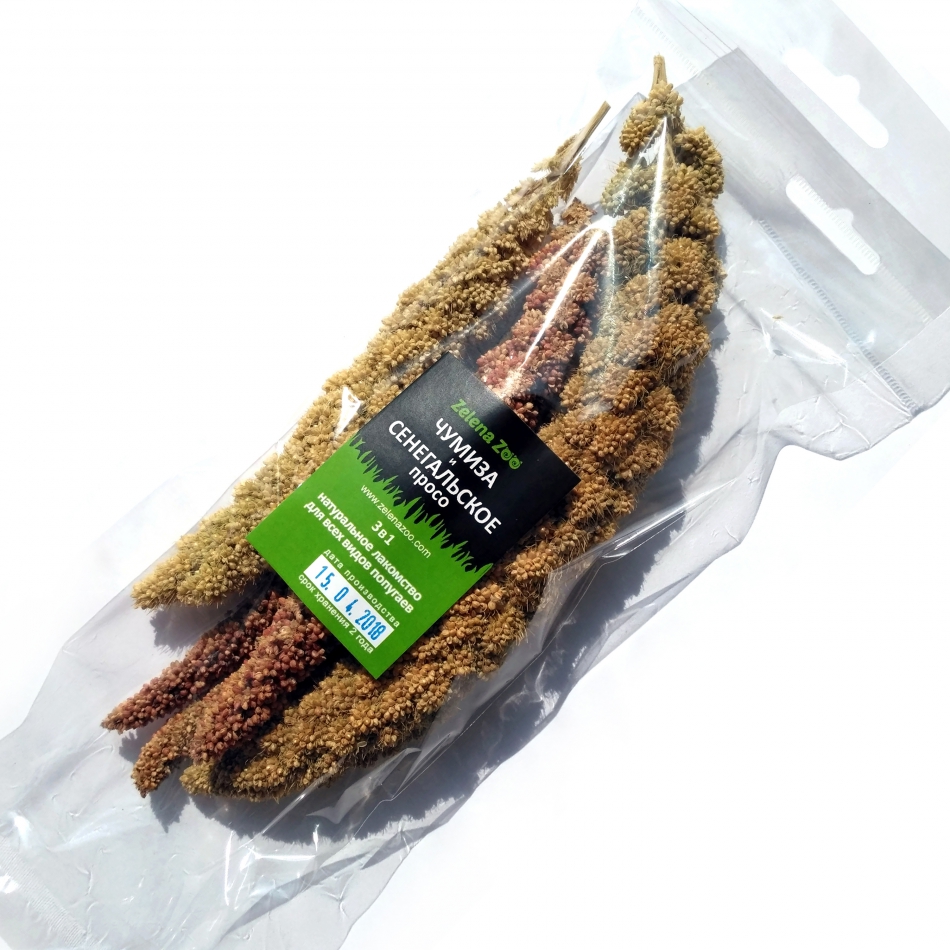
Zelena Zoo foxtail and Senegal millet, 30 g is a natural millet-spray treat from the Zelena Zoo brand. The ingredients are 100% Senegal millet with no additives. The sprays are given alongside the main food once or twice a week. In our catalogue it sits in the bird section, and the manufacturer also recommends it for hamsters, rats and other small rodents. Husking seeds from a spray is a natural activity that entertains your pet and satisfies its urge to forage.
Why birds need millet sprays
In the wild, small seed-eating birds such as budgies, canaries and finches pick seeds straight from plants. In a cage, food sits in a dish and there's much less to do. A spray hung between perches turns feeding into play: your bird climbs, plucks seeds and stays active. It's a good way to prevent boredom. More on diet in budgie food and care.
Key specs
| Parameter | Value |
|---|---|
| Type | millet-spray treat |
| Ingredients | 100% Senegal millet |
| Weight | 30 g |
| For | birds, small rodents |
| How to give | 1–2 times a week with the main food |
| Brand | Zelena Zoo |
Pros
- Natural. Nothing but millet.
- Natural behaviour. Your bird forages for the seeds.
- Beats boredom. Something to do in the cage.
- For training. Budgies love millet, making it a handy reward.
- For birds and rodents. Suits several species.
- A small pack. 30 g is handy for trying it out.
Cons
- A treat only. It doesn't replace the main food.
- Energy-dense. Millet is mostly carbohydrate, and too much leads to obesity.
- Not for herbivores. Guinea pigs, rabbits and chinchillas need hay and herbs.
- Name vs ingredients. The name mentions foxtail millet, but only Senegal millet is listed.
Giving it to birds
Fix a piece of spray between the cage bars or in a holder. For a budgie or canary, a small piece once or twice a week is enough. A bird that fills up on millet eats less of its main food, so don't give sprays daily. If your bird is overweight, keep treats to a minimum. For main foods, see our reviews of Vitakraft Premium Menu and Versele-Laga Prestige Canaries.
Millet in budgie training
A millet spray is one of the most prized rewards for budgies and other small parrots. Break off a few seeds or let your bird nibble the tip of the spray for the right action — it makes it easier to teach stepping onto your hand and going back into the cage. Count these seeds towards the weekly treat total.
Giving it to rodents
For hamsters and rats, which are seed-eaters, a millet spray works as a treat and a toy. Give a small piece once or twice a week and watch your pet while it eats. Grain isn't suitable for guinea pigs, rabbits, chinchillas or degus, whose digestion is built for hay and herbs; for them choose herbal treats such as Zelena Zoo Meadow Flower Mix. On feeding hamsters, see hamster care and feeding.
If you keep several birds
In a cage with several birds, hang the spray where everyone can reach it, or give a few small pieces in different spots. Otherwise the bossiest bird will claim the treat, the others will miss out and squabbles may start.
Storage
Keep the sprays in a cool, dry place in a closed pack so the grain doesn't get damp or attract insects. Check each spray before giving it: if there's mould, webbing or an off smell, throw it away.
Other Zelena Zoo treats
The brand also makes other natural sprays, such as flax on the stem. All bird treats and vitamins are in the bird treats and vitamins section.
Verdict
Zelena Zoo foxtail and Senegal millet is a natural spray of 100% Senegal millet: a favourite treat for budgies and canaries, a handy training reward and entertainment for hamsters and rats. The downsides are that it's an energy-dense treat rather than food and it doesn't suit herbivorous rodents.
FAQ
What's in it?
100% Senegal millet.
How often should I give it?
1–2 times a week alongside the main food.
Which birds is it for?
Budgies, canaries, finches and other small seed-eating birds.
Can hamsters and rats have it?
Yes, a small piece as a treat.
Can guinea pigs have it?
No, hay and herbal treats are better for them.
Can I feed only millet?
No, it's a treat, not a main food.
How much does the pack weigh?
30 g.