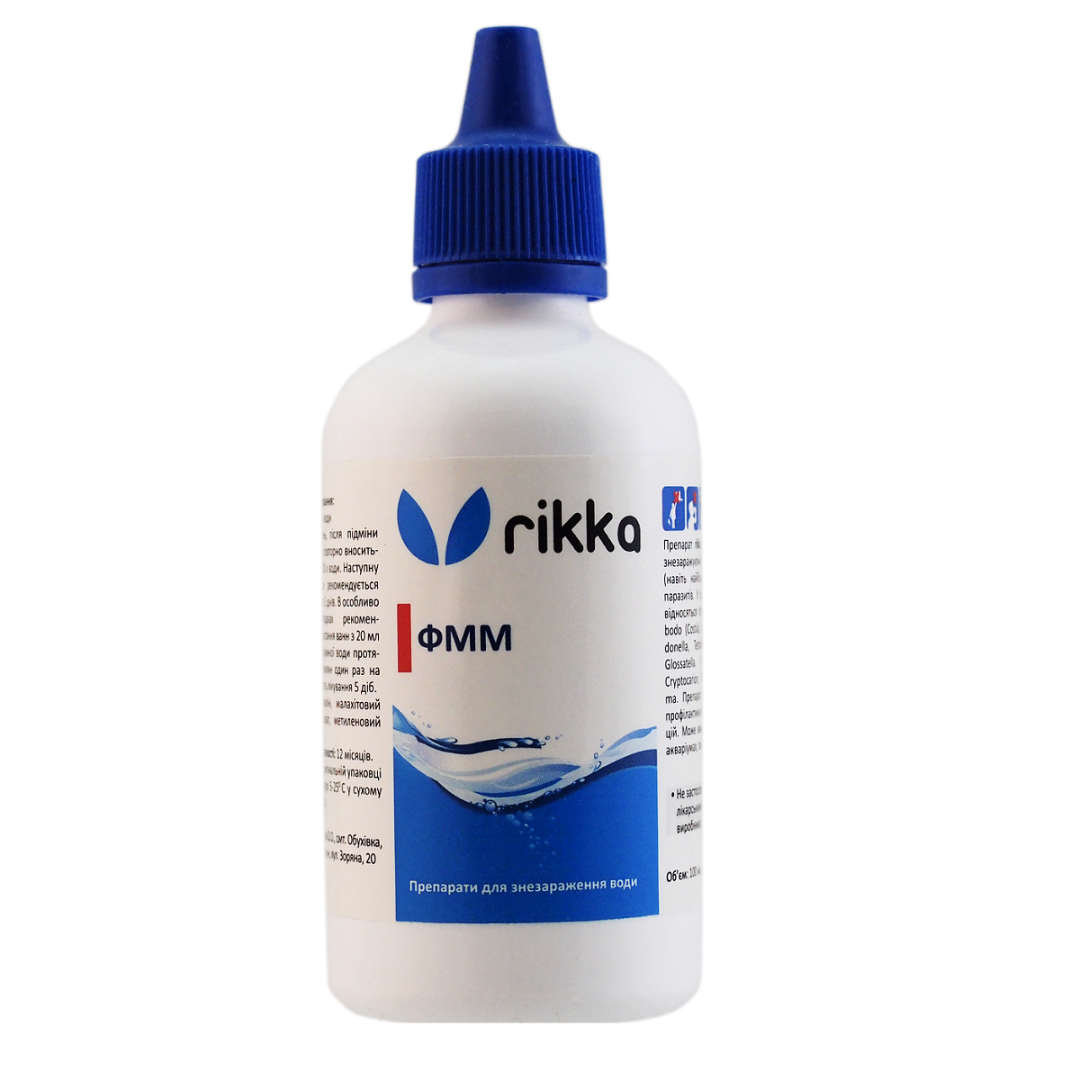
Rikka FMM, 100 ml is a disinfecting treatment from the Ukrainian maker Rikka against external fish parasites. It's used to kill parasites on the body and gills and for prevention. In fresh water it acts on Ichthyophthirius (the cause of white spot), Ichthyobodo (Costia), Chilodonella, Tetrahymena, Trichodina, Glossatella and other parasites, and in salt water on Cryptocaryon, Brooklynella and Uronema. It's also effective against bacterial and fungal infections and can be used in both display and breeding tanks.
Ingredients and how it works
The name FMM comes from its three active ingredients: formalin, methylene blue and malachite green oxalate. This is a classic combination in fishkeeping: malachite green and formalin are lethal to protozoan parasites, while methylene blue acts against bacteria and fungi and eases breathing when the gills are affected. Together they cover a broad range of pathogens. The active ingredients tint the water slightly, but the colour fades over time.
Key specs
| Parameter | Value |
|---|---|
| Active ingredients | methylene blue, malachite green oxalate, formalin |
| Targets | protozoan parasites, bacterial and fungal infections |
| Water | fresh and salt |
| Dosage | 10 ml (300 drops) per 100 l |
| Baths | 20 ml per 10 l, 20–30 minutes, 5 days |
| Shelf life | 12 months |
| Volume | 100 ml |
Pros
- Broad spectrum. Ichthyophthirius, Costia, Trichodina, Chilodonella and more.
- Fresh and salt water. Also works against marine parasites.
- Against bacteria and fungi. Extra protection for weakened fish.
- Detailed instructions. Treatment plan, baths and what to do after an overdose.
- For breeding tanks. Can be used for prevention.
- Affordable. A 100 ml bottle treats 1,000 l of water.
Cons
- Dangerous for invertebrates. Shrimp and snails must be removed; corals are harmed.
- Scaleless fish are sensitive. Loaches and catfish get half the dose.
- Stains decor. It can tint plastic and clear silicone seams.
- No mixing. Don't use with products from other manufacturers.
Treatment plan
Before starting, give a long-uncleaned biofilter a light clean: a dirty filter partly deactivates the medicine, but don't wash away all the beneficial bacteria. Add 10 ml (300 drops) per 100 l of water. On the third day, change 30–50% of the water and add another 10 ml per 100 l. Make the next water change 5 days later. In particularly severe cases, baths are used: 20 ml per 10 l of tank water for 20–30 minutes once a day for 5 days. During treatment, it's best not to feed the fish or to feed very little. If you overdose, replace half the water straight away.
After treatment
Filter the water through activated carbon for 24 hours, then remove it. For a week, add a product that helps restore the slime coat daily (in fresh water) and bacteria for the filter — for example, Rikka AKVA START. During and after treatment, test ammonium and nitrite daily: if nitrite is above 0.5 mg/l, change 50% of the water and add bacteria. Rikka also makes another white spot treatment, Ichthyocid, but the two must not be combined.
Who it suits
Fishkeepers whose fish have white spot, costiasis, trichodiniasis or other parasitic diseases, and for prevention in quarantine and breeding tanks. Not for use on fish intended for human consumption. More products are in the fish medicines and water care section.
Verdict
Rikka FMM is a strong classic treatment based on formalin, malachite green and methylene blue against a broad range of parasites, bacteria and fungi. It has a detailed treatment plan and an affordable price. But it needs careful handling: remove invertebrates, lower the dose for scaleless fish and monitor water quality.
FAQ
Does it treat white spot?
Yes, it acts on Ichthyophthirius, the cause of white spot disease.
What's the dosage?
10 ml (300 drops) per 100 l of water, repeated on the third day after a water change.
Can it be used with shrimp?
No, shrimp and snails must be moved out before treatment.
Is it safe for catfish?
Start scaleless fish on half the dose.
Does it colour the water?
Slightly, and the tint fades over time; it can stain plastic and silicone.
Can I feed the fish during treatment?
It's best not to feed them, or to give very little.
How should it be stored?
In the original packaging at 0–25 °C, away from sunlight and out of children's reach.
Can it be combined with other medicines?
No, the manufacturer prohibits combining it with other manufacturers' products.