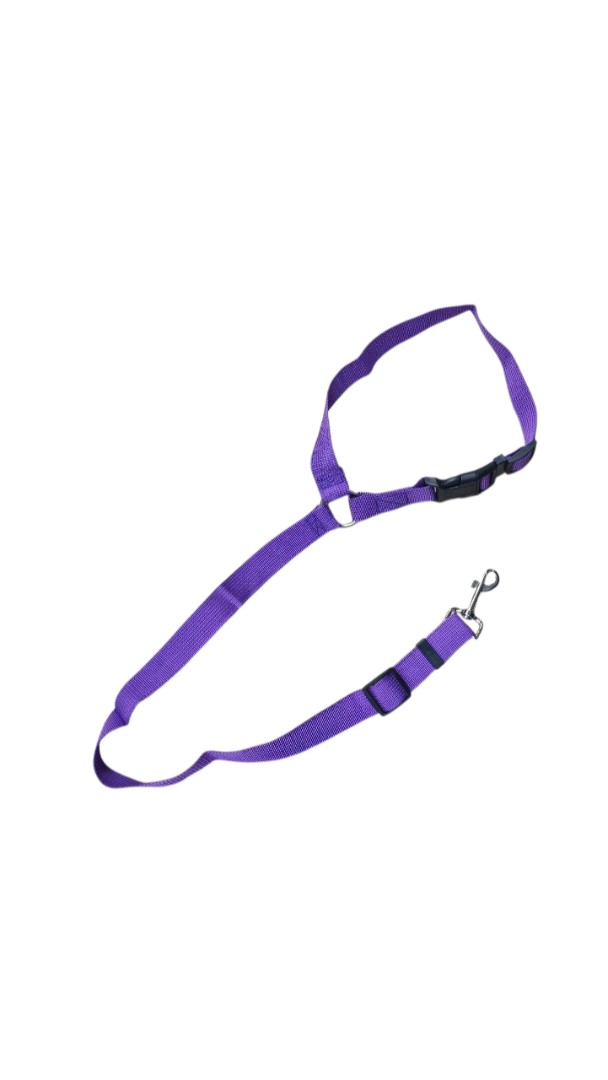
The Harness Safety Seat Belt Purple is an accessory for transporting a dog by car. One end clips into the car's standard seat belt buckle, and the other attaches to the dog's harness with a snap hook. The belt limits the dog's movement around the car while driving, braking and turning. The length adjusts between 41–71 cm, or 33–55 cm in the second position, with a 2.5 cm wide strap; the purple colour is easy to spot.
Why buckle up your dog
An unrestrained dog distracts the driver and is at risk itself. When you brake hard, inertia throws the animal forward into a seat back or the dashboard. A dog that roams around the car can also jump out of an open door into the road or climb onto the driver. The belt solves these problems: you can set the length so the dog can sit or lie down comfortably but can't reach the driver or jump out of the door.
Key specs
| Parameter | Value |
|---|---|
| Attachment | to the car's standard seat belt buckle |
| Length | 41–71 cm or 33–55 cm in the second position |
| Width | 2.5 cm |
| Clips to | the dog's harness |
| Colour | purple |
| For | dogs of different sizes |
Pros
- The dog stays put. The driver isn't distracted.
- Protection when braking. The belt holds the dog in place.
- No jumping out of the door. The length is set to suit the dog.
- Quick to attach. Clip into the buckle, snap on the hook — done.
- Adjustable length. Suits small, medium and large dogs.
- Cheap and compact. Easy to keep in the car.
Cons
- Harness only. Never clip it to a collar — a jolt would load the neck.
- No crash-test data. It limits movement but doesn't replace a certified carrier or crate.
- Check the buckle. Make sure the tongue fits your particular car's buckle.
- Not in the front seat. Dogs are safer in the back.
How to buckle up your dog
Put a well-fitted harness on your dog — see harness or collar: which to choose and how to put a harness on a dog. Sit the dog on the back seat, push the belt tongue into the buckle until it clicks and clip the hook to the ring on the back of the harness. Adjust the length: the dog should be able to sit and lie down freely but not reach the front seats or the door. A belt that's too long defeats the purpose; one that's too short won't let the dog get comfortable.
Travel tips
Walk your dog before the trip and don't give it a big meal — this reduces the risk of car sickness. On long journeys, stop every 2–3 hours for water and a stretch. Never leave a dog in a closed car in hot weather — the interior heats up within minutes. If your dog is afraid of car trips, build up gradually: first just sitting in the car, then short drives to nice places. What to pack just in case is listed in an emergency bag for cats and dogs.
Who it suits
Owners who often take their dog along: to the vet, the country house, out of town or on holiday. Suits dogs of different sizes, as long as the dog wears a harness. More gear is in the walking gear and accessories section.
Verdict
The Harness Safety Seat Belt is a simple, affordable way to buckle up a dog: it clips into the car's own buckle and a harness, and the length is adjustable. It makes trips calmer for the driver and safer for the pet. Use it only with a harness, on the back seat, and set the length so the dog can't reach the driver.
FAQ
Can the belt be clipped to a collar?
No, only to a harness: under hard braking a collar loads the neck.
How long is the belt?
It adjusts between 41–71 cm, or 33–55 cm in the second position.
How does it attach in the car?
It clips into the car's standard seat belt buckle.
Is it suitable for large dogs?
Yes, it's designed for dogs of different sizes; for very large dogs a travel crate is more comfortable.
Where should the dog sit?
On the back seat.
Does the belt replace a carrier?
No, it limits the dog's movement; it isn't certified crash protection.
Can a cat travel this way?
Cats are safer in a closed carrier secured with the car's seat belt: this restraint is designed for a dog in a harness.
How wide is the strap?
2.5 cm.