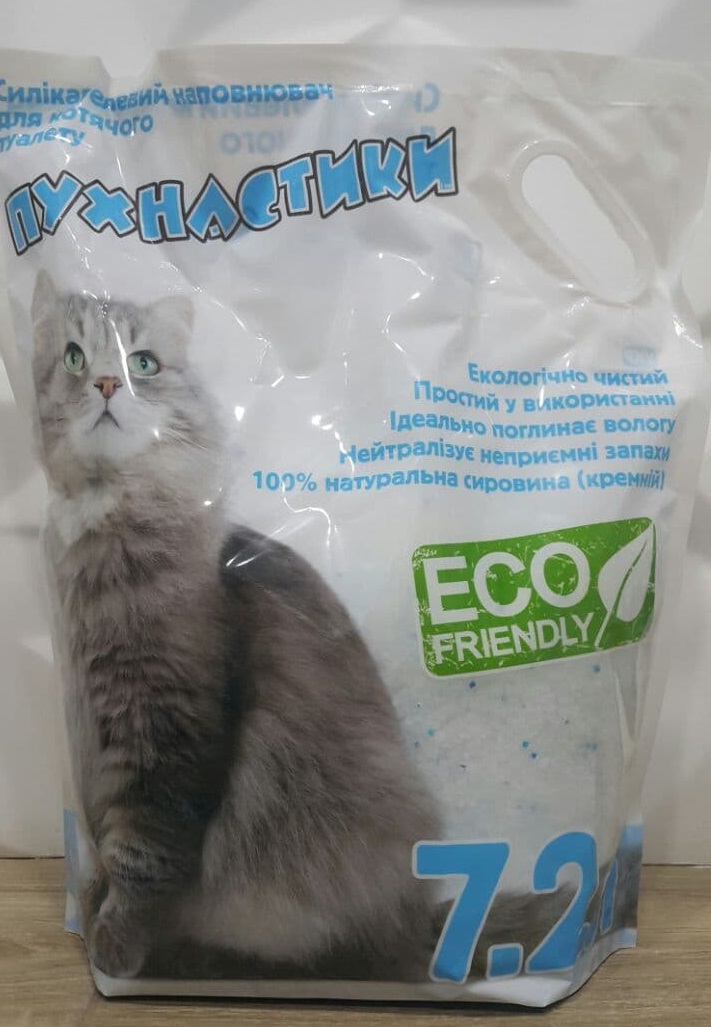
Pushistiki silica gel litter, 7.2 l is an absorbent litter for a cat toilet. According to the description, silica gel absorbs moisture well and neutralises unpleasant odours: liquid soaks into the granules almost instantly and is locked inside, and the granules do not turn into a shapeless mass. As they become saturated the granules change colour, first turning cloudy and then yellow, which shows how far the litter has been used. The manufacturer recommends a 3–5 cm layer, removing solid waste regularly, stirring every 1–2 days and replacing it completely about once a month.
Key specifications
| Parameter | Value |
|---|---|
| Type | silica gel, absorbent |
| For | cats |
| Volume | 7.2 l |
| Indicator | granules turn cloudy, then yellow |
| Layer in the tray | 3–5 cm |
| Stirring | every 1–2 days |
| Full change | about once a month |
Pros
- Absorbs moisture and odour well. The main strength of silica gel.
- Saturation indicator. The colour of the granules shows when to change it.
- Infrequent full changes. About once a month for one cat.
- Does not turn to mush. The granules keep their shape.
- Thin layer. 3–5 cm is enough.
- Clear guidance. The pack explains tray care.
Cons and what to watch
- "Made from natural silicon" is inaccurate. Silica gel is industrially produced silicon dioxide.
- No weight on the card. The weight field shows the volume of 7.2 l, and the "6.1–10 kg" category does not match it.
- "Not tracked on paws" is a promise. Small granules are sometimes still carried out of the tray.
- Not flushable. Dispose of it with household waste only.
- Crunching granules. Some cats dislike the feel.
How to use
Pour the litter into a dry, clean tray to a depth of 3–5 cm. Scoop out solid waste regularly. Stir the litter every 1–2 days so that moisture spreads evenly through the granules and the top layer does not oversaturate. Replace the litter completely about once a month and wash the tray. If the granules turn yellow sooner or a smell becomes noticeable, change the litter without waiting. Liners make a full change easier, for example CROCI Rolly.
How silica gel works
Silica gel granules are porous: liquid and odour compounds enter the pores and are held there. That is why silica gel does not clump but absorbs. The colour change shows that the pores are filling up. Litter types are compared in how to choose cat litter.
How long it lasts
It depends on tray size, the number of cats and the depth of the layer. The manufacturer suggests a full change about once a month. With several cats the litter saturates faster and needs changing more often.
Why it cannot be flushed
The manufacturer warns clearly: do not throw the litter into the toilet. The granules do not dissolve in water and can block the drains. More in can cat litter be flushed down the toilet.
If your cat refuses it
If your cat is used to another litter, switch gradually: mix the old litter with the new one, increasing the share of silica gel over several days. If the cat still avoids the tray, read cat not using the litter tray: what to do. Choosing the tray itself is covered in which litter tray to choose for a cat.
Kittens
Young kittens sometimes taste litter. If a kitten chews the granules, it is better to switch for a while to a litter that is safer if swallowed, such as the soy-based CROCI Tofu Clean. More in how to litter train a kitten.
Storage
Keep the bag closed in a dry place: silica gel absorbs moisture from the air and can become saturated before use. Keep it out of reach of children.
Who it suits
Pushistiki 7.2 l suits owners of adult cats who want infrequent litter changes and good odour control. Other options are in the silica gel litter collection and the cat litter section; for comparison see the review of Kotix silica gel 10 l.
Verdict
Pushistiki 7.2 l is a silica gel litter that quickly absorbs moisture and odour, does not turn to mush and shows saturation by changing colour, with a full change needed about once a month. The downsides are the inaccurate "natural silicon" claim, no weight on the card, granules occasionally tracked out on paws, and it cannot be flushed.
FAQ
How deep should the layer be?
3–5 cm.
How do I know when to change it?
The granules turn cloudy and then yellow.
How often should it be fully replaced?
About once a month.
Does it need stirring?
Yes, every 1–2 days.
Can it be flushed?
No.
Does it clump?
No, silica gel absorbs moisture rather than clumping.
What volume is it?
7.2 l.