
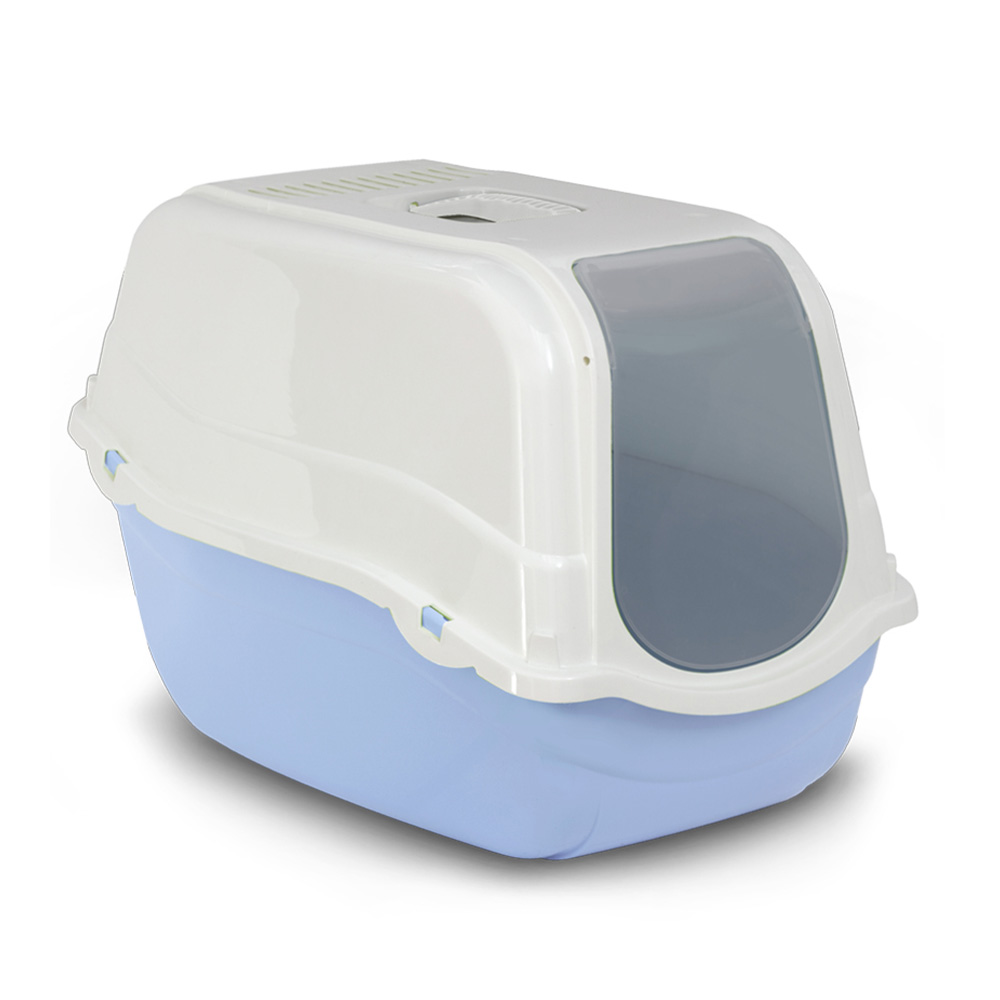
A cat's litter tray should be roomy — about one and a half times the length of the cat from nose to base of the tail — with an easy entrance and a stable base. Most cats do well with an open high-sided tray: litter doesn't scatter and nothing gets in the cat's way. A covered tray keeps smell and litter inside better, but not every cat likes it. You should have one more tray than you have cats, placed somewhere quiet and away from the food bowls.
Types of litter trays
| Type | Pros | Cons |
|---|---|---|
| Open, low-sided | Easy for kittens and senior cats, easy to clean | Litter scatters |
| High-sided or with a rim | Keeps litter in, suits most cats | A high entrance is awkward for kittens and seniors |
| With a grid | Can be used without litter or with large pellets | Doesn't suit every cat, needs frequent washing |
| Corner | Saves space in a small bathroom | Usually small |
| Covered (hooded) | Keeps smell and litter inside, gives privacy | Smell concentrates inside, some cats feel cramped |
An open tray with a rim such as the Moderna Arist-O-Tray is a versatile choice. If your cat digs enthusiastically, try a high-rimmed model like the MPS Netta Open. If you want less smell and litter on the floor, there are covered trays such as the MP Bergamo Romeo or the Moderna Flip Cat with a flip-up lid.
The size rule
Measure your cat from nose to base of the tail and multiply by 1.5 — that's roughly how long the tray should be. For an average cat that's 45–55 cm; for Maine Coons and other large breeds from 60 cm. In a small tray a cat can't turn around and dig, so it looks for somewhere else. For a kitten you can buy a tray it will grow into, but with a low entrance.
How many trays you need
The rule used by vets and cat behaviourists is one tray more than the number of cats: two for one cat, three for two. In a large or two-storey home, put the trays in different places. This reduces conflict between cats and helps if one of them dislikes using a dirty tray.
Where to put the tray
- somewhere quiet where your cat won't be disturbed;
- away from food and water bowls — cats don't eat where they toilet;
- not next to the washing machine or other noisy appliances;
- where your cat has a view and an escape route: a nervous cat may avoid a corner under the stairs;
- accessible around the clock: doors should not close it off.
Litter and cleaning
- Scoop clumps and solids 1–2 times a day.
- Replace all the litter and wash the tray: clumping litter every 2–4 weeks, absorbent litter more often, as it gets wet.
- Wash the tray with warm water and no strong-smelling cleaners: the smell of bleach and ammonia puts cats off.
- Replace the tray if the plastic is badly scratched: smells cling to scratches.
Litter is in the cat litter section; scoops, mats and liners are in litter tray accessories.
If your cat goes outside the tray
- Check that the tray is clean and that you haven't changed the litter or its location.
- Check the size and entrance: the tray may be cramped or the rim too high.
- Add a second tray in another place.
- If your cat goes often in small amounts, strains, there's blood in the urine or it cries in the tray, see a vet urgently: it may be cystitis or urinary stones.
Litter trays in different sizes and shapes are in the cat toilets section. Nova Poshta delivery across Ukraine.
Frequently Asked Questions
Which is better: an open or a covered tray?
Most cats are happy with either. An open tray is easier to keep clean; a covered one holds smell and litter better. If your cat won't use a covered tray, take the lid off.
What size tray does a Maine Coon need?
At least 60 cm long with high sides, or a large covered toilet — the cat must be able to turn around freely.
Can I put the litter tray on a balcony?
Only if it's insulated: on a cold balcony in winter a cat may start holding on and looking for somewhere warmer.
How often should I replace the tray itself?
A plastic tray gets scratched and absorbs smells over time. If the smell remains even after washing, it's time for a new one.



