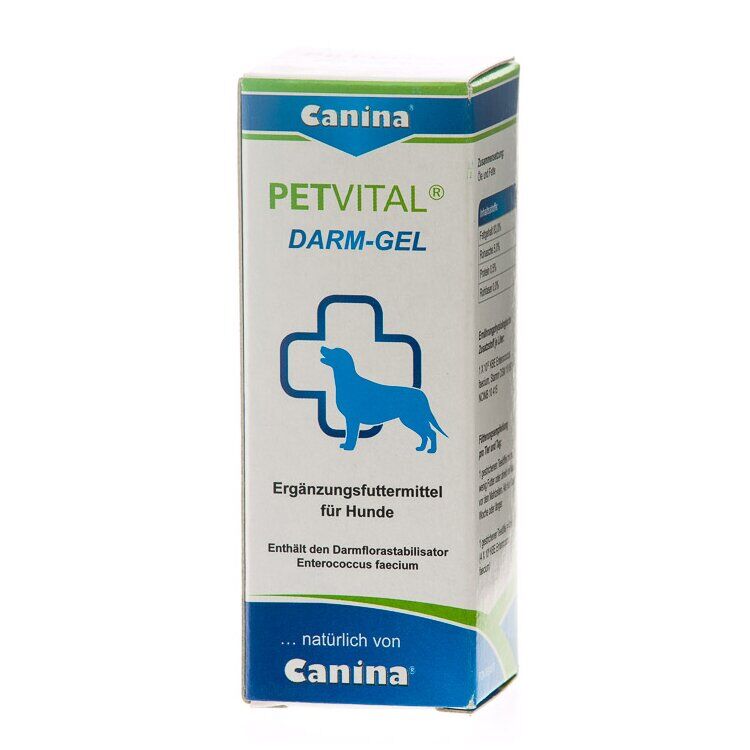
Canina PETVITAL Darm-Gel, 30 ml is a gel from the German brand Canina for restoring a dog's gut flora. Its active component is the lactic acid bacterium Enterococcus faecium (strain DSM 10663/NCIMB 10415), stated by the maker at 1×10¹² CFU. It's used after antibiotics and with stress, food changes and other situations where the balance between beneficial and opportunistic bacteria is disturbed and diarrhoea appears.
What it is and how it works
Canina is a German maker of animal supplements, and PETVITAL is its range for supporting the body in special situations. Enterococcus faecium multiplies quickly and colonises the gut lining, crowding out pathogenic flora and preventing it from multiplying. This stabilises the natural gut flora and lowers the risk of upsets after antibiotics, stress or a switch to new food. The gel format is handy because it can go straight into the mouth even if the dog eats poorly.
Content and dosage
| Parameter | Value |
|---|---|
| Probiotic | Enterococcus faecium DSM 10663/NCIMB 10415 |
| Analysis | protein 4%, fat 0.5%, ash 1%, potassium 0.2% |
| Dose | 1 teaspoon (about 4 ml) a day |
| How to give | before a meal, into the mouth or with a little food |
| Course | on average 7–10 days |
Pros
- A proven strain. Enterococcus faecium is widely used in animal supplements.
- After antibiotics. Helps restore gut flora.
- Stress and food changes. Lowers the risk of gut upsets.
- Convenient form. The gel is easy to give by mouth.
- Short course. Usually 7–10 days.
Cons and what to keep in mind
- Small volume. At 4 ml a day, 30 ml lasts about a week.
- One dose for all. A teaspoon a day regardless of the dog's weight.
- Doesn't treat the cause. Worms, infections and poisoning need their own treatment.
- Dogs only. As stated in the product description.
How to give it
Give one teaspoon of gel (about 4 ml) a day before a meal, straight into the mouth or mixed with a little food so the dog eats the whole dose. The average course is 7–10 days. If the gel is needed during antibiotic treatment, it's convenient to give it at a different time of day from the tablets; check the schedule with your vet. Fresh water should always be available, especially with diarrhoea.
When diarrhoea is dangerous
With diarrhoea the body quickly loses water and salts, and dehydration impairs the internal organs. If loose stools last more than 1–2 days, or there's blood, vomiting, lethargy, refusal to eat or fever, or if it's a puppy or an older dog, see a vet rather than relying on a probiotic alone. For a mild upset, small bland meals, plenty of water and adsorbents such as Presorb or Dolvit Stopper help.
Avoiding upsets when changing food
The most common cause of "sudden" diarrhoea in a healthy dog is an abrupt food change or table scraps. Switch to a new food gradually over 7–10 days by mixing it with the old one. During the transition and after antibiotics, a probiotic supports the gut well. More in how to switch your pet to a new food. Another probiotic option is ProbioBona.
Who it suits
Dogs after a course of antibiotics, during stress, moving house or a food change, and with mild digestive upsets. For regaining strength after illness there's Canina Energy-Gel. Other supplements are in vitamins and mineral supplements.
Verdict
Canina PETVITAL Darm-Gel is a probiotic gel with Enterococcus faecium to restore a dog's gut flora. Convenient support after antibiotics, stress and food changes with simple dosing, but serious or prolonged diarrhoea needs a vet first.
Storage and feeding during the course
Probiotics are sensitive to heat and moisture, so keep the tube tightly closed somewhere cool and dry, and check the expiry date. During the course, feed your dog its usual food in small portions 2–3 times a day, and avoid fatty or smoked food and table scraps. Even if stools return to normal after antibiotics, finish the course so the gut flora has time to recover. Once the gut settles, gradually return to the usual feeding and walking routine.
Frequently Asked Questions
How much Darm-Gel for a dog?
One teaspoon (about 4 ml) a day before a meal.
How long is the course?
On average 7–10 days.
Which probiotic does it contain?
Enterococcus faecium, strain DSM 10663/NCIMB 10415.
Can it be given with antibiotics?
It's used to restore gut flora after antibiotics; check the schedule alongside treatment with your vet.
Can cats have it?
The product description lists it for dogs.
How long does a tube last?
30 ml at 4 ml a day lasts about a week.