
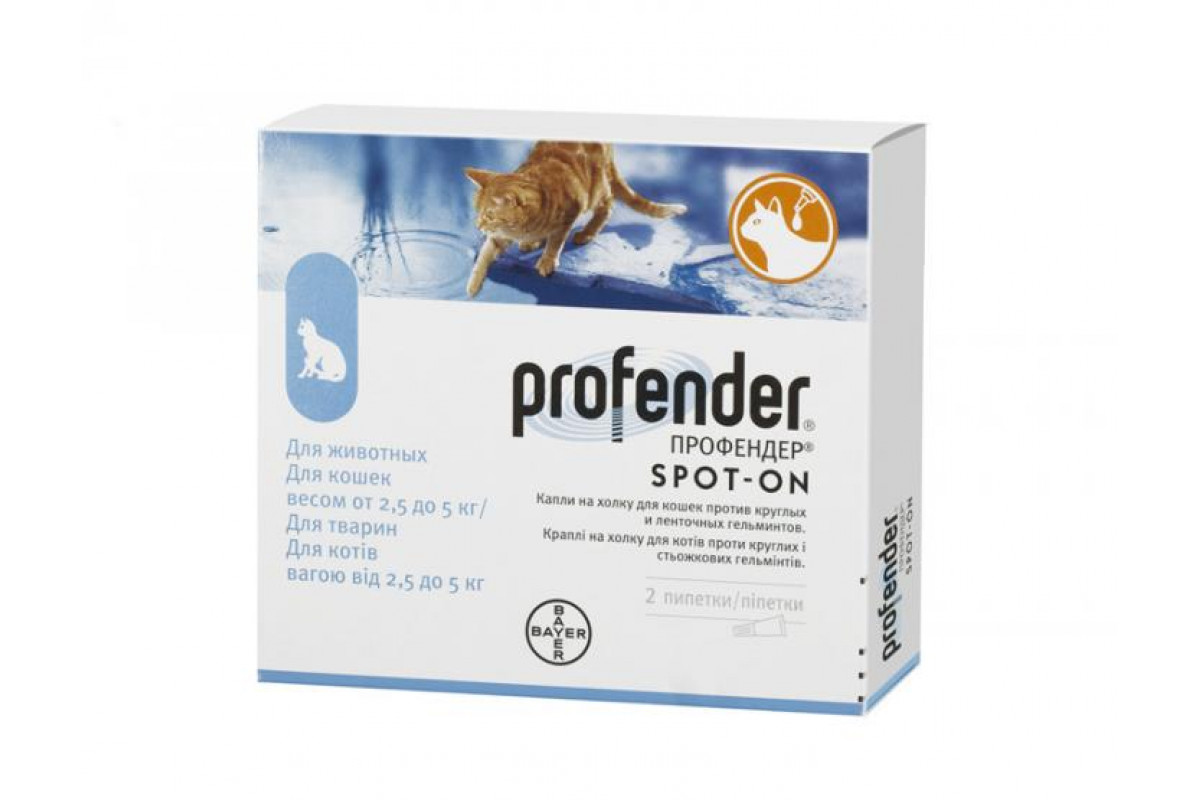
Profender Spot-On for cats 2.5–5 kg is a dewormer applied to the skin at the base of the neck. Each ml contains 21.43 mg of emodepside and 85.75 mg of praziquantel: emodepside acts on roundworms, praziquantel on tapeworms. One 0.7 ml pipette is for a cat of 2.5–5 kg, applied once. Kittens can be treated from 8 weeks of age and 0.5 kg. The main advantage: no need to open the cat's mouth and push in a tablet.
What it is and who makes it
Profender was developed by Bayer and is now made by Elanco (Germany). The ingredients are absorbed through the skin into the bloodstream, so the drops work from the inside like a tablet. There are three strengths: 0.35 ml for cats and kittens of 0.5–2.5 kg, 0.7 ml for cats of 2.5–5 kg and 1.12 ml for cats of 5–8 kg (our catalogue has a pack of Profender for cats 5–8 kg). Cats over 8 kg get a combination of pipettes at 0.14 ml per kg.
Which worms it treats
| Group | Parasites |
|---|---|
| Roundworms (nematodes) | Toxocara cati, Toxascaris leonina, Ancylostoma tubaeforme |
| Tapeworms (cestodes) | Dipylidium caninum (flea tapeworm), Taenia taeniaeformis, Echinococcus multilocularis |
How to apply it correctly
- Weigh your cat and choose the pipette for its weight band.
- Part the fur at the base of the neck between the shoulder blades, where the cat can't lick.
- Squeeze the entire contents directly onto dry, intact skin, not onto the fur.
- Don't let the cat or other pets lick the area until it has dried.
- Wash your hands after treatment.
Pros
- No tablets. A lifesaver for cats that spit out pills and scratch.
- Roundworms and tapeworms. Two ingredients cover the main intestinal worms of cats.
- Single treatment. One pipette is enough for routine deworming.
- For kittens. From 8 weeks and 0.5 kg — there's a small pipette.
- Accurate dosing. Weight-banded pipettes, nothing to split.
Cons and what to keep in mind
- Costs more than tablets. Spot-ons usually cost more than classic dewormers.
- Must not be licked. If the cat licks it, drooling and vomiting can occur — apply strictly at the back of the neck.
- For cats only. These drops are not intended for dogs.
- No flea protection. Fleas spread the flea tapeworm, so without flea control reinfection will happen.
How often to treat your cat
Indoor cats usually need routine treatment every 3 months; outdoor cats and hunters more often, as your vet advises. Deworming is also done 10–14 days before vaccination. If there are fleas at home, deal with them first — see fleas on cats, and for a general schedule read worms in cats and dogs.
Who it suits
Cats that can't be given a tablet, cats that are fearful or aggressive during treatment, and kittens from 8 weeks. If you need flea and worm protection at the same time, look at combination spot-ons in parasite control.
Verdict
Profender is one of the easiest ways to deworm a cat: one pipette on the neck, with no stress and no tablet battles. It costs more than tablets, but treatment takes a minute. Read the leaflet before use, and treat pregnant, nursing or sick cats only after consulting your vet.
How to tell your cat has worms
Infection often goes unnoticed, so deworming follows a schedule rather than symptoms. Watch for white segments like grains of rice in the stool or on the fur near the tail, vomiting, a swollen belly in kittens, a dull coat, weight loss despite a good appetite, and scooting on the floor. With these signs, see a vet, who will choose the product and regimen — especially if the cat is weak or pregnant.
Frequently Asked Questions
How quickly does Profender start working?
The ingredients are absorbed through the skin within a few hours; treatment is given once.
Can I stroke my cat after Profender?
Don't touch the application site until it's dry, and don't let children stroke the cat there on the day of treatment.
Is Profender suitable for kittens?
Yes, from 8 weeks and 0.5 kg — there's a 0.35 ml pipette for them.
Can Profender be used on dogs?
No, this product is intended for cats.


