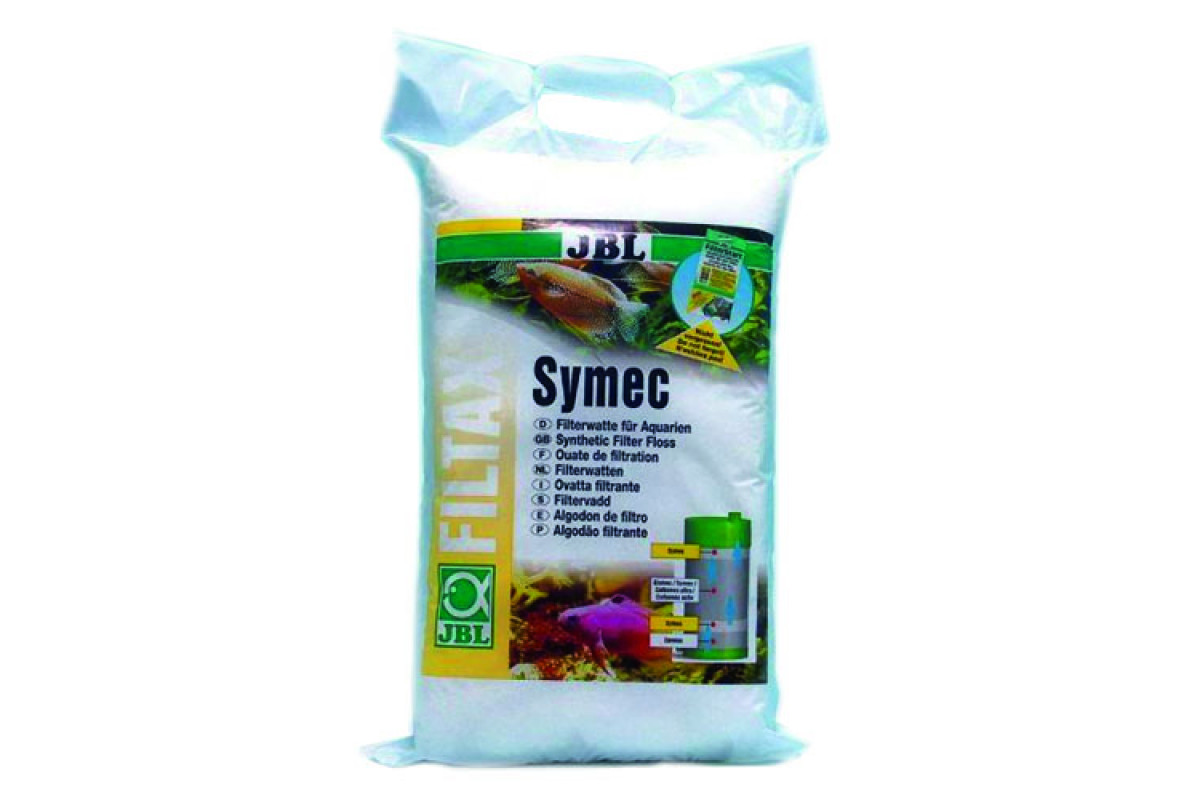
JBL Symec Filter Floss, 500 g is a synthetic filter fibre from the German brand JBL for aquarium filters. According to the manufacturer, it quickly removes cloudiness in freshwater and marine tanks: fine fibres trap any haze and suspended particles, leaving the water crystal clear. The material is fully synthetic and doesn't break down, so it releases no pollutants or fibres into the water. Place it as the final filtration stage in whatever amount suits your filter. It can be rinsed, but the manufacturer recommends replacing it instead. Replace it when the water flow through the filter drops. The pack contains one 500 g bag.
Where cloudiness comes from
Plant debris, leftover food and fish waste lower water quality. Some of it is fine suspended matter that passes through the filter sponge and makes the water look cloudy. Fine fibre acts as a "polisher", catching what gets past the coarser stages. More on equipment in aquarium for beginners: what to buy.
Key specs
| Parameter | Value |
|---|---|
| Type | synthetic filter fibre |
| Purpose | removing cloudiness and suspended matter |
| Aquariums | freshwater and marine |
| Position in filter | final filtration stage |
| Material | fully synthetic, non-degrading |
| Weight | 500 g |
| Brand | JBL, Germany |
Pros
- Clear water. Traps fine haze.
- For fresh and salt water.
- Releases nothing harmful. Synthetic and non-degrading.
- Fits any filter. Cut and pack it to size.
- A large pack. 500 g lasts a long time.
- Rinsable. Though replacing is better.
Cons
- Clogs quickly. Especially in a neglected tank.
- A consumable. Needs regular replacement.
- Doesn't remove dissolved substances. Ammonia and nitrite remain.
- Doesn't replace biofiltration. Works alongside a sponge.
How to fit it
Place the required amount of fibre in the filter as the last stage — after the sponges and biological media. Coarse particles are caught earlier, and the floss "polishes" the water. Pack it snugly against the walls: the manufacturer warns there should be no gap between the inner wall of the filter and the material, or water will bypass it.
When to replace it
Replace the floss when the flow through the filter drops noticeably. It can be rinsed, but fine particles lodge deep inside, so replacement is more effective. It's handy to cut a piece to size from the large pack and keep spare floss to hand.
Floss vs sponge
The sponge catches coarse dirt and houses the beneficial bacteria of the biofilter — it's rinsed, not thrown away. The floss is responsible for water clarity and is replaced as a consumable. The two complement each other. To support filter bacteria, use products such as Tetra Bactozym.
If the water is still cloudy
If cloudiness persists, the cause may be a bacterial bloom in a new tank, overfeeding or overstocking. Test the water with something like Tetra Test 6in1. For quick clearing there are conditioners such as JBL Clynol or Rikka Clear Water.
How much to use
The manufacturer doesn't set a limit: use as much fibre as fits in the filter compartment. Don't pack it too tightly — a dense wad clogs quickly and cuts the flow. Lay it in an even layer without lumps or gaps. In an external filter, floss usually goes in the top basket; in an internal filter, in a separate compartment after the sponge.
Storage
Keep the pack somewhere dry and clean, away from household chemicals, so the fibre doesn't absorb odours or substances. Cut off pieces with clean hands or scissors.
Who it suits
Freshwater and marine aquarium owners who want crystal-clear water and use internal, external or hang-on filters with a compartment for fine filtration. More equipment is in the aquarium equipment section.
Verdict
JBL Symec Filter Floss is a synthetic fibre for the final stage of an aquarium filter that traps haze and fine particles in fresh and salt water, releases nothing harmful and fits any filter; a 500 g pack lasts a long time. The downsides are that it clogs quickly and needs regular replacement, doesn't remove dissolved substances and doesn't replace biofiltration.
FAQ
What is filter floss for?
Removing haze and fine particles from the water.
Where does it go?
As the final filtration stage, with no gaps at the walls.
Is it suitable for marine tanks?
Yes, for freshwater and marine tanks.
Can it be rinsed?
Yes, but replacing it is better.
When should I replace it?
When the water flow through the filter drops.
Does it release harmful substances?
No, it's synthetic and doesn't break down.
How much does the pack weigh?
500 g.