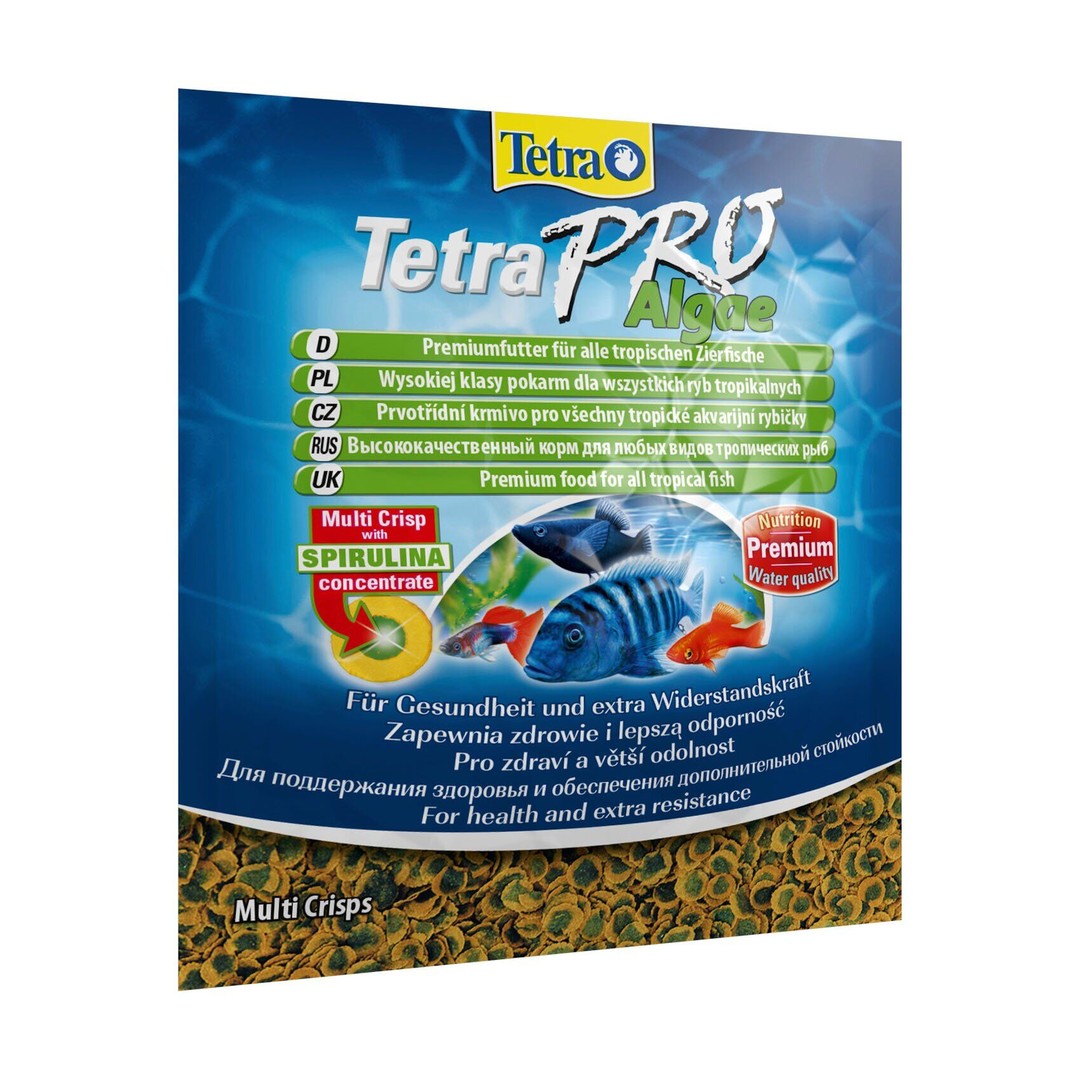
TetraPro Algae, 12 g is a crisp food for tropical fish that, according to the description, is ideal for herbivorous species. It is made with a gentle low-temperature process that preserves nutritional value and vitamin stability. A spirulina concentrate is added to boost resistance. The crisp shape, according to the manufacturer, minimises water pollution and makes feeding easy. The product card's name labels it "Vegetable".
Ingredients
Fish and fish by-products, cereals, vegetable protein extracts, yeasts, molluscs and crustaceans, oils and fats, algae.
Analysis: crude protein 46.0%, crude oils and fats 12.0%, crude fibre 3.0%, moisture 9.0%. Additives: vitamin A 29,810 IU/kg, vitamin D3 1860 IU/kg, L-carnitine 123 mg/kg, manganese 67 mg/kg, zinc 40 mg/kg, iron 26 mg/kg; colourants, preservatives and antioxidants.
Fish comes first in the list and algae last. There are no vegetables listed. The ingredients, analysis and additives are identical to another food in the same range, TetraPro Colour; judging by the description, the only difference is the concentrate, here spirulina.
Key specifications
| Parameter | Value |
|---|---|
| Type | crisp food |
| For | tropical fish, herbivores |
| Concentrate | spirulina |
| Protein | 46% |
| Fat | 12% |
| Vitamins | A 29,810 IU/kg, D3 1860 IU/kg |
| Weight | 12 g |
Pros
- Spirulina. A concentrate to support resistance.
- Gentle production. Low temperatures preserve vitamins.
- Crisps pollute less. According to the manufacturer.
- Vitamins A and D3, L-carnitine. Listed with amounts.
- Easy feeding. Crisps are simple to portion.
- Small sachet. Handy for a trial.
Cons and what to watch
- Algae come last. For a food "for herbivores", fish is the first ingredient.
- "Vegetable" without vegetables. None are listed.
- Same formula as TetraPro Colour. The analysis and additives are identical.
- High protein for herbivores. 46% is a lot for fish that need plant food.
- No feeding guide. 12 g will not last long.
How to feed
Feed the crisps 2–3 times a day in small portions the fish finish within 2–3 minutes. Large fish can take whole crisps; for small fish, crumble them between your fingers. Remove leftovers. More in aquarium fish food: how to feed.
For herbivorous fish
Bristlenose catfish, mollies, many Lake Malawi cichlids and other fish that graze on algae in the wild need food with a high share of plant ingredients. TetraPro Algae can be part of their diet, but it makes sense to add a plant-based food; for small cichlids, for example, Tetra Cichlid Algae Mini.
Compared with other crisps
If you want a staple crisp food in a large tub, see TetraMin Pro Crisps. For all-round feeding, TetraMin flakes also work.
Crisps and clean water
Crisps hold their shape longer than flakes and crumble less, so less food ends up in the substrate. But the key to clean water is not overfeeding. If the water still clouds, check the filter and the amount of food; a clarifier such as Tetra CrystalWater helps temporarily.
Automatic feeder
Crisps work well in an automatic feeder while you are away, for example the Resun AF-2009D. Before leaving, check that they do not jam in the drum.
Storage
Keep the sachet tightly closed in a cool, dry place. Use opened food within a few months so the vitamins do not degrade.
Who it suits
TetraPro Algae suits tropical fish as a supplementary spirulina food and as part of a herbivorous species' diet alongside a plant-based food. Other foods are in the fish food section.
Verdict
TetraPro Algae is a spirulina crisp food made by a low-temperature process, with 46% protein, vitamins A and D3 and L-carnitine. The downsides are that for a "herbivore" food algae come last and fish first, the promised vegetables are absent, the formula is identical to TetraPro Colour, and there is no feeding guide.
FAQ
Which fish is it for?
Tropical fish, especially herbivores according to the description.
What does spirulina do?
According to the description, it boosts resistance.
How much protein?
46%.
Does it contain vegetables?
No vegetables are listed.
How does it differ from TetraPro Colour?
In the concentrate: spirulina here, a colour concentrate there; the analysis is the same.
How often should I feed?
2–3 times a day in small portions.
What does it weigh?
12 g.