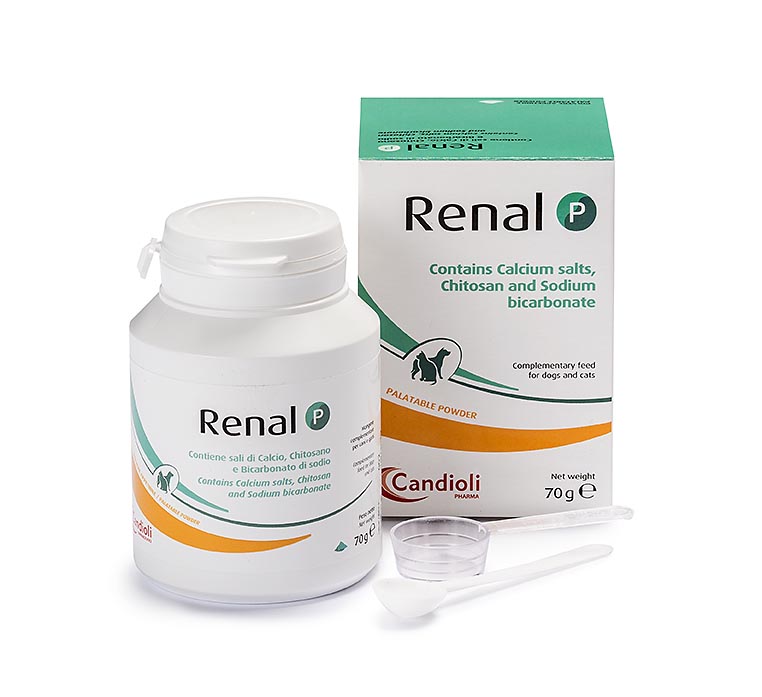
Candioli Renal P, 70 g is a powder from the Italian company Candioli for cats and dogs with chronic kidney disease. According to the manufacturer, it keeps phosphataemia (blood phosphorus) and metabolic acidosis under control. It contains calcium salts (calcium lactate-gluconate and calcium carbonate) that bind dietary phosphorus in the gut; chitosan, which the manufacturer says absorbs phosphorus and nitrogenous compounds and lowers creatinine; and sodium bicarbonate, an alkalising agent to control acidosis. The powder is added to food at 0.2 g per kg of body weight per day for a 30-day course, split into 2–3 servings. Measuring spoons are included: the small one covers 2.5 kg of body weight, the large one 10 kg.
Why bind phosphorus in kidney disease
Diseased kidneys struggle to excrete phosphorus, and excess phosphorus in the blood speeds up the disease and makes the animal feel worse. So for chronic kidney disease, vets prescribe a low-phosphorus diet and, if needed, substances that bind phosphorus from food in the gut so it isn't absorbed. Another common problem is metabolic acidosis — the blood becoming acidic — which is corrected with alkalising agents.
Key specs
| Parameter | Value |
|---|---|
| Type | food supplement powder |
| For | cats and dogs with chronic kidney disease |
| Components | calcium lactate-gluconate, calcium carbonate, chitosan, sodium bicarbonate |
| Action | phosphorus binding, acidosis control |
| Dose | 0.2 g per kg body weight per day, in 2–3 servings |
| Course | 30 days, may be repeated |
| Measuring spoons | small — 2.5 kg, large — 10 kg |
| Weight | 70 g |
| Brand | Candioli, Italy |
Pros
- Binds phosphorus. Calcium salts and chitosan.
- Controls acidosis. Sodium bicarbonate.
- For cats and dogs.
- Easy dosing. Measuring spoons by body weight.
- A powder. Mixes easily with wet food.
- Well tolerated. According to the manufacturer.
Cons
- Only on a vet's advice. Blood tests are needed.
- Amounts per dose aren't listed.
- Awkward with dry food. The kibble needs moistening.
- Doesn't replace a renal diet. It works alongside one.
How the components work
According to the manufacturer, calcium lactate-gluconate and calcium carbonate bind dietary phosphorus in the gut. Chitosan absorbs phosphorus and nitrogenous compounds. Sodium bicarbonate acts as an alkalising agent to control metabolic acidosis; the manufacturer says this may require up to 2 months of continuous use. The manufacturer also notes that long courses don't cause hypercalcaemia unless the animal has a condition that raises calcium on its own.
How to give it
Add the powder to food at 0.2 g per kg of body weight per day, split into 2–3 servings so it works with every meal. Wet food is preferable. If your pet eats only dry food, moisten it slightly so the powder sticks and is fully eaten. The small measuring spoon covers 2.5 kg of body weight, the large one 10 kg.
Course and monitoring
The course is 30 days and may be repeated. After the first course, the manufacturer recommends consulting a vet about whether to continue. In practice, the vet assesses the effect through blood tests — phosphorus, creatinine and acid-base values. Make sure your pet always has plenty of water available.
A renal diet
A phosphorus binder works best together with a therapeutic low-phosphorus diet, such as Brit Veterinary Diet Renal for dogs. Veterinary diets are in the veterinary diets for cats and veterinary diets for dogs sections.
Other Candioli products
For urinary tract support, Candioli offers Cystocure, and for the gut, the probiotic Florentero Act. Use these on your vet's advice too.
Storage
Keep the tub tightly closed somewhere dry and cool, out of reach of children and pets. Use a dry spoon so the powder doesn't get damp and clump.
Who it suits
Owners of cats and dogs with chronic kidney disease whose vet has prescribed a phosphorus binder and acidosis correction based on blood tests. More products are in the medicines section.
Verdict
Candioli Renal P is a powder with calcium salts, chitosan and sodium bicarbonate for cats and dogs with chronic kidney disease: it binds dietary phosphorus and helps control metabolic acidosis, dosed at 0.2 g per kg with measuring spoons over a 30-day course. The downsides are that it should only be used on a vet's prescription with blood test monitoring, amounts per dose aren't listed, and it's awkward with dry food.
FAQ
What is Renal P for?
Controlling phosphorus and metabolic acidosis in chronic kidney disease.
Is it suitable for cats and dogs?
Yes.
What's the dose?
0.2 g per kg of body weight per day, in 2–3 servings.
How long is the course?
30 days, repeated if your vet decides so.
Can it be used with dry food?
Yes, but moisten the kibble slightly.
Does it replace a renal diet?
No, it's used alongside one.
Do I need a vet?
Yes, for prescription and blood test monitoring.