To pad-train a puppy, limit its space, cover the toilet area with pads and put the puppy on them after every nap, meal and play session — for young puppies that's every 1–2 hours. As soon as the puppy goes on the pad, praise it and give a treat straight away. A training spray on the pad helps the puppy understand where to go. Scolding for puddles is pointless — just clean up calmly and treat the spot with an odour neutraliser. Once vaccinations and quarantine are over, the pad is gradually moved towards the door and then the puppy is taught to go outdoors.
What to prepare
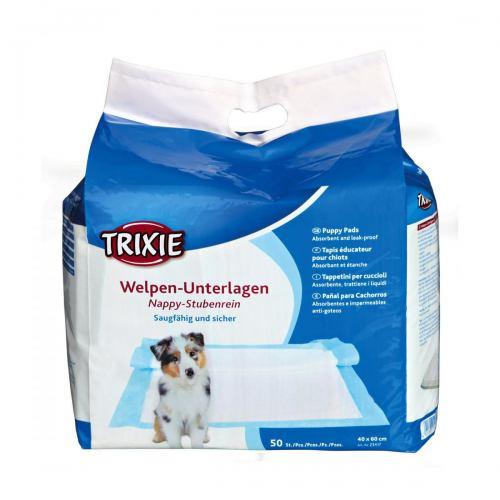
- Pads — plenty of them, sized for the puppy: 40×60 cm for small breeds, 60×60 or 60×90 cm for medium and large. Big packs save money, such as Trixie 40×60 cm, 50 pcs.
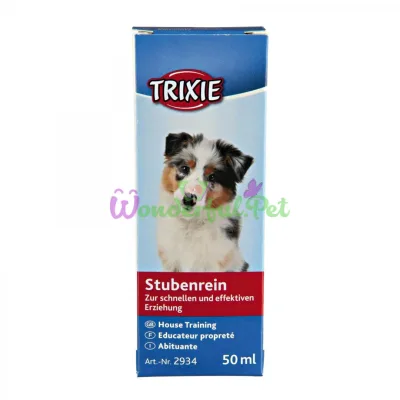
- Training aid — a spray or drops with a scent that attracts the puppy: CROCI GILL'S Puppy Trainer or the Trixie training oil.
- Odour neutraliser for accidents — without bleach or ammonia.
- Treats — small and soft, for an instant reward.
- Optionally, a dog toilet tray with a grid to hold the pad: the puppy can't tear it or drag it around.
Pads, trays and accessories are in the dog toilet accessories and dog toilets sections.
Step by step: pad training
- Limit the space. For the first weeks keep the puppy in one room or a playpen with most of the floor covered in pads.
- Reduce the area. When the puppy starts choosing a particular spot, gradually remove pads, leaving 1–2 where it goes most willingly.
- Time it right. Straight after sleep, 10–20 minutes after eating, after active play and whenever the puppy starts circling and sniffing.
- Praise in the moment. The reward must come within 1–2 seconds of the puppy finishing — otherwise it won't understand why.
- Use scent. Put a drop of training aid on the pad or leave a piece of a previously used pad.
- Clean accidents without fuss. Wipe up the puddle and treat the spot with a neutraliser so the puppy isn't drawn back by the smell.
How long a puppy can hold it
A rule of thumb: a puppy can hold it during the day for as many hours as it is months old, plus one, but no more than 6–8 hours even as it grows. A 2-month-old puppy manages about 2–3 hours, a 4-month-old up to 4–5 hours. Puppies last longer at night, but in the first weeks you'll need to take them to the pad at night too.
How to move from pads to going outdoors
A puppy starts going outside after its vaccination course and quarantine are complete — your vet sets the timing, usually at 3–4 months. More on vaccination timing in vaccinations for puppies and kittens.
- Go outside right after sleep and meals, when the puppy definitely needs to go.
- In the first days you can take a used pad with you and put it on the grass.
- Use the same spot each time and a cue word such as “go potty”.
- As soon as the puppy goes outside, praise it enthusiastically and give a treat.
- Gradually remove the pads at home, leaving one by the door for the transition.
Common mistakes
- Punishment and rubbing the nose in it — the puppy starts hiding and going in secret.
- Cleaning with bleach — the smell resembles urine and draws the puppy back.
- Too much freedom around the home in the first weeks.
- Late rewards, already in the kitchen — the puppy doesn't link them to the toilet.
- Irregular feeding: with food always available it's hard to predict when the puppy needs to go.
A list of everything your puppy needs is in new puppy: what to buy first.
Frequently Asked Questions
How long does it take to pad-train a puppy?
Usually 1 to 3 weeks with consistent effort. Occasional accidents can happen until 4–6 months.
Why does my puppy tear up the pads?
It's play. A tray with a grid or pad holder and plenty of toys help.
Can I train a puppy to go outdoors straight away, without pads?
Yes, once vaccinations are complete. Before that, walking in public places is risky because of infections.
My puppy goes next to the pad — what should I do?
Increase the pad area, use a tray with a rim and a training aid, and treat accident spots with a neutraliser.