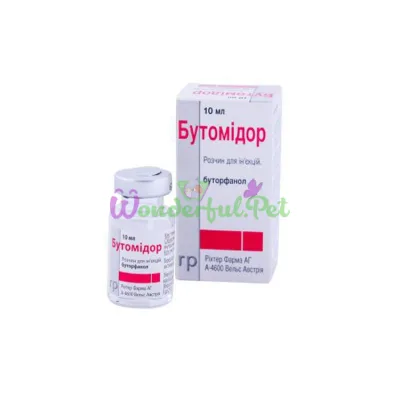
Richter Pharma solution Butomidor 10 ml
- Pickup from our store13 Mala Arnautska St · 1–3 days1–3 daysfree
- Nova Poshta: branch or lockerdispatched tomorrow · 1–5 work days1–5 work daysNP ratesfree from ₴1370
- Nova Poshta courierto your door · 1–5 work days1–5 work daysNP ratesfree from ₴2500
- Brand
- Richter Pharma
- Pharmacological group
- Painkillers, sedatives, antispasmodics
- Product form
- Solution
- Product type
- Medicines and supplements
- Package type
- Bottle
- Volume
- 10 ml
- Animal
- For dogs, For cats, For horses
- Brand registration country
- Austria
Richter Pharma Butomidor solution for post-operative and post-traumatic pain in cats and dogs 10 ml
Clear, colourless solution.
Composition: 1 ml of the product contains the active substance butorphanol (as tartrate) 10 mg.
Excipients: benzethonium chloride, sodium chloride, water for injection.
Pharmacological properties:
Butorphanol is an analgesic from the group of synthetic opioids with an agonist-antagonist effect.
In addition to pain relief, the product has a calming effect, from mild to moderate sedation depending on the species.
This is especially evident when the product is used as part of combined anaesthesia and / or neuroleptanalgesia.
Breathing slows, as when animals naturally fall asleep, and the heart rate decreases at the same time.
The duration and intensity of analgesia depend on the dose and individual sensitivity (increasing the dose or repeating the injection does not increase the maximum effect).
The product starts to work after 5-15 minutes, depending on the route of administration; the duration depends on the dose (pain relief can last up to 4 hours).
Butorphanol is not a psychotropic substance; it is metabolised in the liver and excreted in urine and faeces.
Use:
Horses:
Analgesic:
Short-term pain relief for moderate to severe pain, such as colic.
Sedation and pre-anaesthesia: in combination with α2-adrenoceptor agonists (detomidine, xylazine, romifidine): for therapeutic and diagnostic procedures such as minor standing surgery and sedation of unruly animals.
Dogs/Cats:
Analgesic:
For severe pain, e.g. before and after surgery, post-traumatic pain. Sedative: in combination with α2-adrenoceptor agonists (medetomidine).
Pre-anaesthetic:
As part of an anaesthetic protocol (medetomidine, ketamine).
Dosage for dogs (intravenous, subcutaneous and intramuscular)
Pain relief:
Monotherapy: 0.1-0.4 mg butorphanol per 1 kg of body weight (0.1-0.4 ml per 10 kg of body weight), slowly, intravenously (within the low or medium dose range), as with intramuscular or subcutaneous administration.
To control post-operative pain, the injection should be given 15 minutes before the end of anaesthesia to keep pain relief during recovery from anaesthesia.
Sedation:
With medetomidine: 0.1 mg butorphanol per 1 kg body weight (0.1 ml per 10 kg body weight) intravenously or intramuscularly, 0.01 mg medetomidine per 1 kg body weight, intravenously or intramuscularly.
Pre-anaesthesia:
With medetomidine and ketamine
0.1 mg butorphanol per 1 kg of body weight (0.1 ml per 10 kg of body weight) intramuscularly, 0.025 mg medetomidine per 1 kg of body weight intramuscularly, after 15 min: 5 mg ketamine per 1 kg of body weight intramuscularly.
If the effect is prolonged with ketamine, do not use the antagonist atipamezole.
Cats (intravenously and subcutaneously)
Pain relief:
Monotherapy: 15 min before waking, one of two options: 0.4 mg butorphanol per 1 kg of body weight (0.2 ml per 5 kg of body weight) subcutaneously; or 0.1 mg butorphanol per 1 kg of body weight (0.05 ml per 5 kg of body weight) intravenously.
Sedation:
With medetomidine: 0.4 mg butorphanol per 1 kg of body weight (0.2 ml per 5 kg of body weight) subcutaneously and 0.05 mg medetomidine per 1 kg of body weight subcutaneously. Additional local anaesthesia is recommended for wound treatment. The antagonist of medetomidine (once the ketamine has worn off) is atipamezole at 0.1 mg per 1 kg of body weight.
Horses (intravenous only)
Pain relief:
Monotherapy: 0.1 mg butorphanol per 1 kg of body weight (1 ml per 100 kg of body weight) intravenously; may be repeated if necessary. The need for and timing of repeat doses should be based on the animal's clinical condition.
Sedation and pre-anaesthesia:
With detomidine: 0.012 mg detomidine per 1 kg body weight intravenously, followed a few minutes later by 0.025 mg butorphanol per 1 kg body weight (0.25 ml per 100 kg body weight) intravenously.
With romifidine: 0.05 mg romifidine per 1 kg body weight, followed 5 minutes later by 0.02 mg butorphanol per 1 kg body weight (0.2 ml per 100 kg body weight) intravenously.
With xylazine: 0.5 mg xylazine per 1 kg body weight intravenously, followed 3-5 minutes later by 0.05 - 0.1 mg butorphanol per 1 kg body weight (0.5-1 ml per 100 kg body weight), intravenously.
Contraindications:
Hypersensitivity to the active substance or to any other components of the product, respiratory depression, heart disease, skull injuries, organic brain disorders, functional liver and kidney disorders, seizures and constipation.
In combination with α2-adrenoceptor agonists in horses, do not use if cardiac arrhythmia is known.
Combined use reduces gastrointestinal motility, so use with care in colic associated with impaction.
Precautions:
Avoid stress factors for the animals.
Observe aseptic rules and restrain the animal safely.
Do not mix products in one syringe.
Do not give combined injections at the same site.
In some cases, mainly depending on the dose, temporary bradypnoea occurs, along with a drop in blood pressure and bradycardia, similar to sleep.
Pain at the injection site is possible with IM and subcutaneous administration.
Cats sometimes show mydriasis, disorientation and depression.
In horses, butorphanol slows intestinal motility (duodenum, caecum, beginning of the large colon).
3 Before using the product, a detailed clinical examination of the animal should be carried out to better assess any possible risk of cardiovascular, liver, nervous system and lung dysfunction.
The combination of butorphanol/detomidine hydrochloride or medetomidine hydrochloride should be avoided in animals with cardiac arrhythmia or bradycardia, and in horses prone to colic, due to the cardiovascular effect of alpha-2 agonists.
When an additional anaesthetic is used, «fasting» of the animal is required in some cases.
Atropine can be used, if necessary, as a typical parasympatholytic.
To calculate the dose for small animals, you need to know their exact body weight.
Presentation:
A clear 10 ml glass vial closed with a rubber stopper and aluminium crimp cap.
Storage:
Store below 25 °C.
Keep the bottle in its box to protect it from light.
Shelf life - 3 years. 28 days after first use.
Manufacturer: Richter Pharma, Austria
Reviews
No reviews yet
Be the first to review this product.