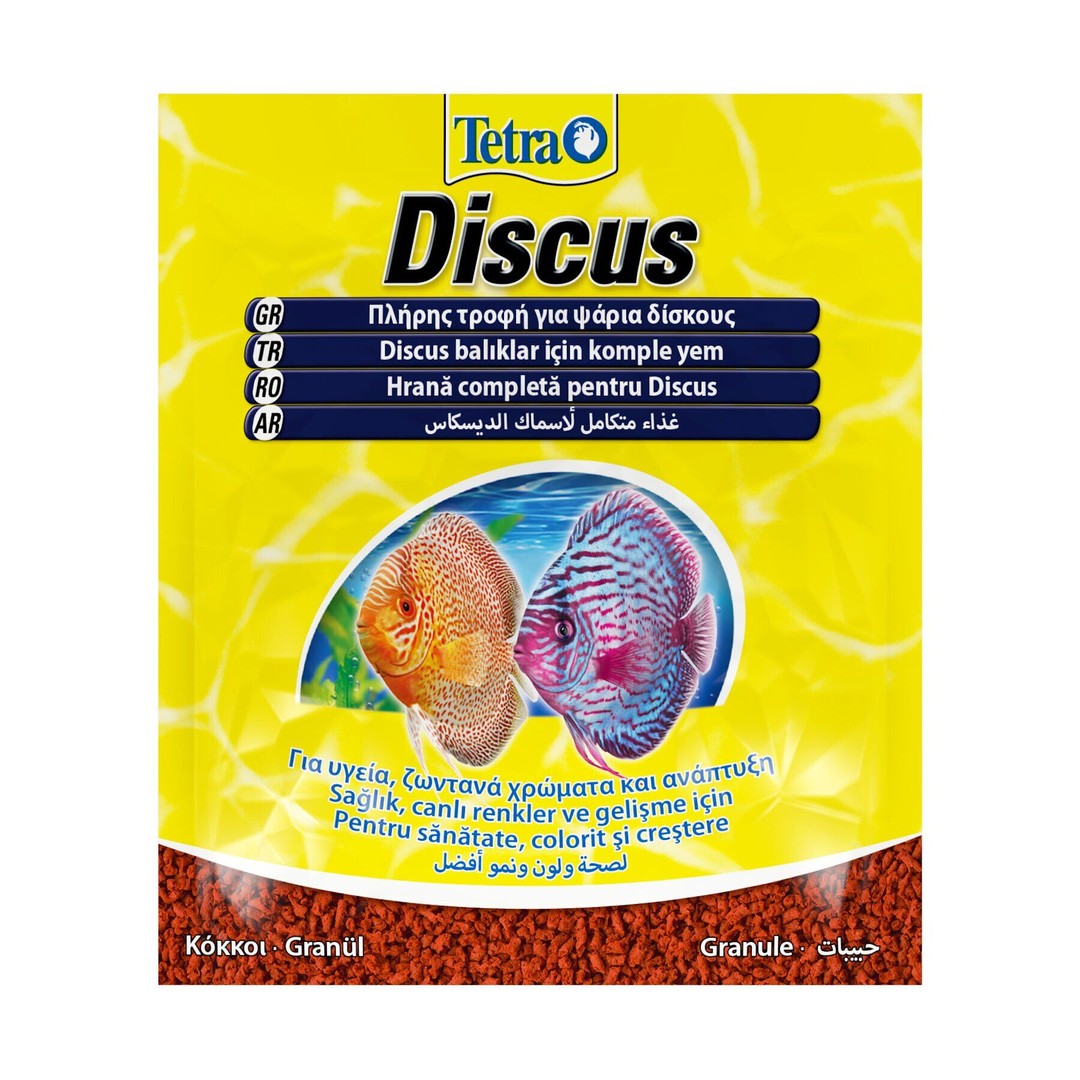
Tetra Discus, 15 g is a staple granule food for discus from the German brand Tetra. The colour, composition and shape of the granules are tailored to discus: the granules sink slowly into mid-water, where these fish like to feed. According to the manufacturer, the food contains a complete set of vitamins, nutrients and trace elements, and supports natural colour, vitality and disease resistance.
What's inside
Ingredients: fish and fish by-products, vegetable protein extracts, cereals, vegetable products, molluscs and crustaceans, yeasts, minerals, algae, oils and fats. Analysis: protein 48%, fat 7%, fibre 2%, moisture 6%. Additives per kg: vitamin A 29,770 IU, vitamin D3 1,860 IU, manganese 67 mg, zinc 40 mg, iron 26 mg, plus colourants, preservatives and antioxidants. The manufacturer highlights stabilised vitamin C, which boosts disease resistance, speeds up growth and eliminates signs of undernourishment.
Key specs
| Parameter | Value |
|---|---|
| For | discus |
| Form | slow-sinking granules |
| Protein / fat | 48% / 7% |
| Fibre / moisture | 2% / 6% |
| Vitamins | A, D3, stabilised C |
| Pack | 15 g |
Pros
- Made for discus. Shape, colour and formula suited to their needs.
- High protein. 48% — discus need a protein-rich diet.
- Slow-sinking. Fish can eat the granules in mid-water.
- Vitamin C. A stabilised form for disease resistance.
- Safer than frozen food. No risk of introducing infections.
- A handy trial pack. 15 g to see whether your fish like it.
Cons
- Contains colourants and preservatives. They're listed among the additives.
- A small pack. 15 g won't last long with a group of discus.
- Not the only food. Discus benefit from variety.
- Leftovers foul the water. Uneaten granules must be removed.
How to feed
Feed discus several times a day in small portions — as much as they'll eat in 2–3 minutes. The granules sink slowly, so discus feeding in mid-water can catch them. Siphon out any uneaten food after a few minutes: discus are sensitive to water quality, and leftover food quickly raises ammonia and nitrite. Introduce a new food gradually, mixing it with the usual one. General feeding rules are covered in aquarium fish food: how to feed.
A varied diet
Granules work well as the base of the diet, alternated with other foods for variety — flakes, tablets and colour-enhancing foods. The manufacturer stresses that granule food is safer than frozen food, as it doesn't bring pathogens into the tank. If you're just starting out, read an aquarium for beginners, and for cycling the biofilter, bacteria help — see our Rikka AQUA START review.
Water and discus health
Even the best food won't help if the water is poor: discus need warm, clean, soft water and regular water changes. Overfeeding is a common cause of trouble — excess food goes uneaten, rots and poisons the water. If your fish darken, hide, refuse food or develop white spots, check the water parameters and start treatment if needed — see our Rikka ICHTHYOCID review for parasite treatment.
Who it suits
Discus keepers who want a convenient, high-protein staple food; the small 15 g pack is good for trying it out. More foods are in the fish food section.
Verdict
Tetra Discus is a specialist granule food with 48% protein, vitamins A and D3 and stabilised vitamin C that sinks slowly, the way discus like it. A good, safe base for their diet. Note the colourants and preservatives, feed small portions and keep the menu varied.
FAQ
How much protein does it contain?
48% protein and 7% fat.
Do the granules sink?
Yes, they sink slowly into mid-water.
How often should discus be fed?
Several times a day, in small portions they can finish in 2–3 minutes.
Can discus live on these granules alone?
It's a staple food, but discus benefit from variety.
Does it contain vitamin C?
Yes, stabilised vitamin C.
Is it suitable for other fish?
It's made for discus; other cichlids can eat it too, but it's best to choose food for the specific species.
How should the food be stored?
Tightly closed, in a cool, dry place: opened food loses vitamins, especially vitamin C.
How much does the pack weigh?
15 g.