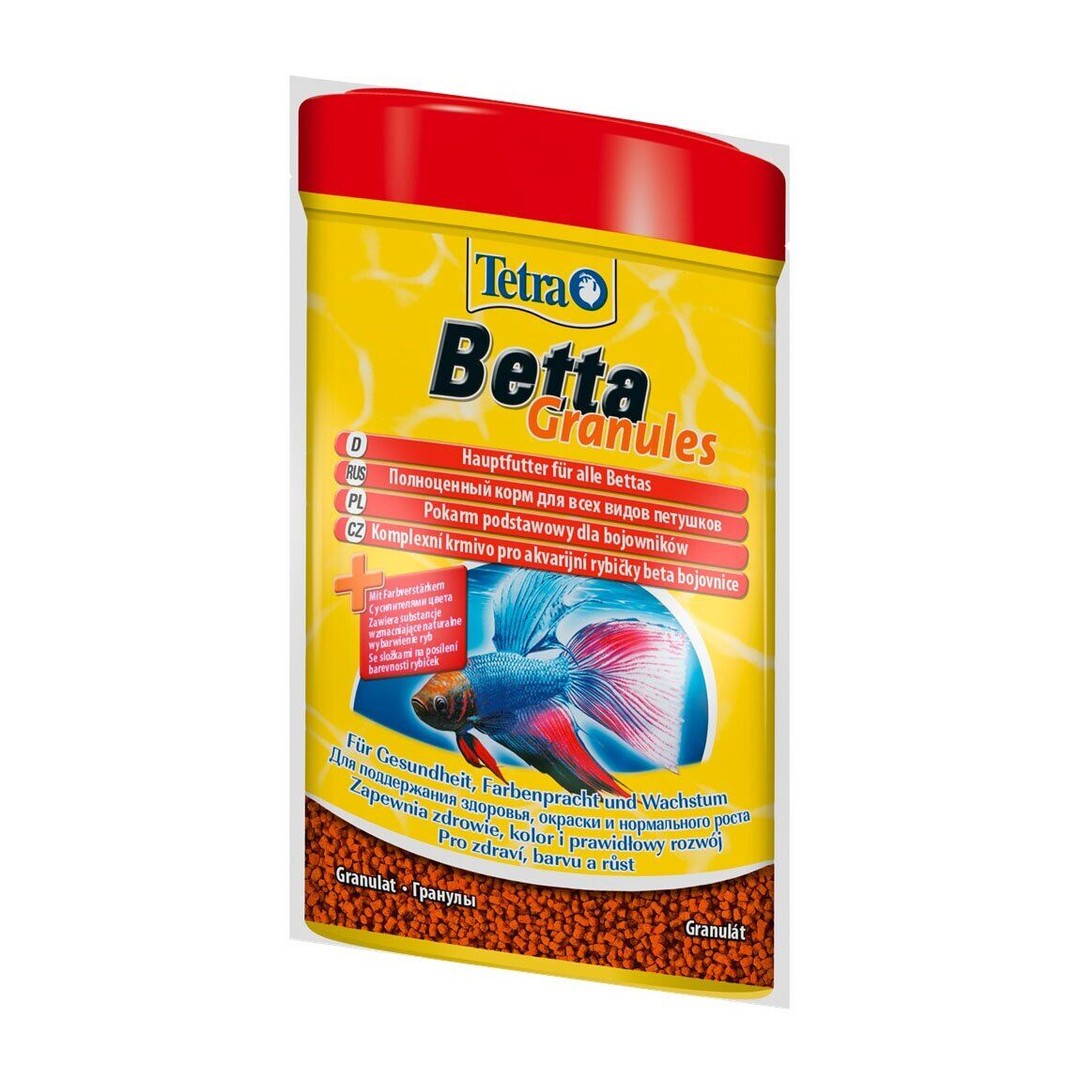
Tetra Betta Granules, 5 g is a balanced, nutritious food for bettas. According to the description, these are highly palatable floating granules with natural colour enhancers that help the fish keep its beautiful colouring. The food is enriched with vitamins and nutrients to support the immune system and does not cloud the water. The granules stay at the surface, which is where bettas usually feed.
Ingredients
Cereals, vegetable protein extracts, fish and fish by-products, oils and fats, yeasts, molluscs and crustaceans, minerals and algae.
Analysis: crude protein 43.0%, crude oils and fats 10.0%, crude fibre 2.0%, moisture 8.0%. Additives: vitamin A 28,760 IU/kg, vitamin D3 1795 IU/kg, manganese 100 mg/kg, zinc 60 mg/kg, iron 39 mg/kg; colourants and antioxidants.
Protein is high at 43% and fat is 10%. However, cereals and vegetable protein come first and fish only third. For a betta, which feeds mainly on insects and their larvae in the wild, this is not an ideal order, although the protein analysis is good.
Key specifications
| Parameter | Value |
|---|---|
| Type | floating granules |
| For | bettas (Siamese fighting fish) |
| Feature | natural colour enhancers |
| Protein | 43% |
| Fat | 10% |
| Vitamins | A 28,760 IU/kg, D3 1795 IU/kg |
| Weight | 5 g |
Pros
- Made for bettas. Formulated specifically for this fish.
- Floating granules. Bettas take food from the top.
- Colour enhancers. For vivid colouring.
- High protein. 43%.
- Does not cloud the water. According to the manufacturer.
- No preservatives in the additive list. Only colourants and antioxidants are listed.
Cons and what to watch
- Cereals come first. Fish is only third.
- No feeding guide. And overfeeding is especially dangerous for bettas.
- Colour enhancers not named.
- Small pack. 5 g, though the food will not go stale.
- Contains colourants.
How to feed
A betta's stomach is roughly the size of its eye, so portions must be tiny: usually 2–4 granules once or twice a day. Make sure the fish eats everything at once and remove any uneaten granules. Many fishkeepers give a betta one fasting day a week, which helps prevent bloating and constipation. More in aquarium fish food: how to feed.
Signs of overfeeding
If the betta's belly is noticeably swollen, the fish is sluggish and rests on the bottom or at the surface, and granules are left uneaten, cut portions and pause feeding for a day or two. If it does not improve, consult a fish specialist.
Variety
Bettas benefit from variety: alternate the granules with other colour foods, such as crumbled TetraPro Colour crisps, and with live or frozen food if available.
Where to keep a betta
Bettas need warm water at around 25–28 °C, gentle flow and hiding places. A tank of just over 20 litres, such as the Priroda 22 l, suits a single betta well. Heaters are chosen by volume: the mini AquaLighter aHEATER MINI is rated for tanks up to 15 l. Strong filter flow bothers bettas, as their long fins make them poor swimmers.
Colour
A betta's brightness depends not only on food but also on mood, water quality and lighting. Under daylight, such as from the AquaLighter Nano, the colours look natural. Paleness often signals stress or illness.
Storage
Keep the pack tightly closed in a cool, dry place. The small 5 g pack is handy, as the food is used up before the vitamins degrade.
Who it suits
Tetra Betta Granules suit bettas as a staple food, provided portions are tiny and the diet is varied. Other foods are in the fish food section.
Verdict
Tetra Betta Granules are floating granules for bettas with natural colour enhancers and vitamins A and D3, 43% protein and 10% fat, that do not cloud the water. The downsides are cereals listed before fish, unnamed colour enhancers, added colourants and no feeding guide, even though overfeeding is especially dangerous for bettas.
FAQ
Which fish is it for?
Bettas.
Do the granules float?
Yes.
How much should I give?
Usually 2–4 granules once or twice a day.
How much protein?
43%.
Does it contain preservatives?
The additive list shows only colourants and antioxidants.
Is a fasting day needed?
Many fishkeepers give one once a week.
What does it weigh?
5 g.