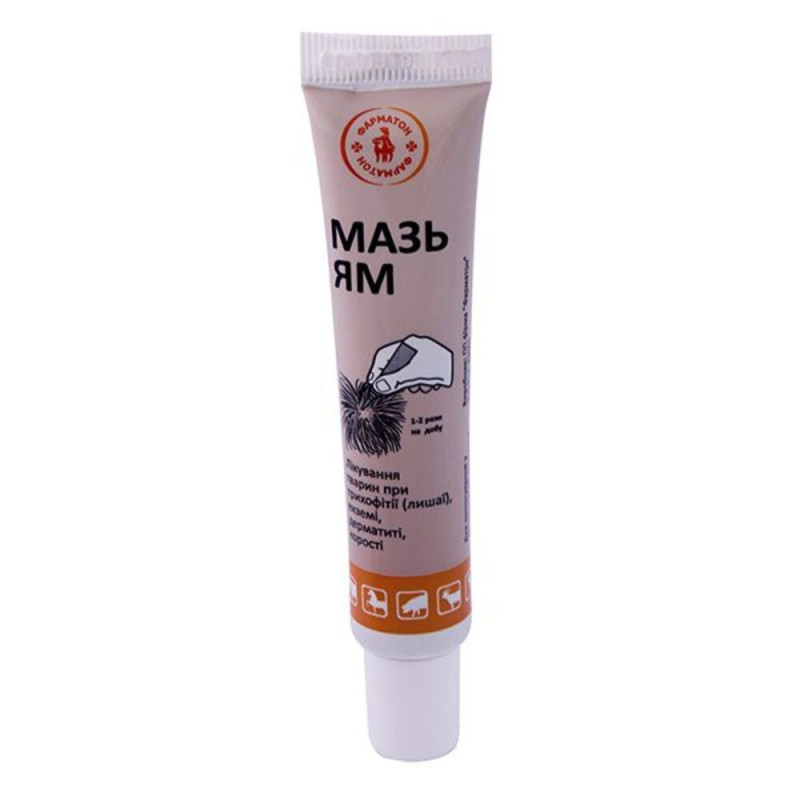
YAM ointment by Farmaton, 15 g is a veterinary product from the Ukrainian company Farmaton (Rivne) for treating skin diseases in dogs, rabbits and farm animals. Each gram contains 30 mg salicylic acid, 100 mg sulphur, 100 mg zinc oxide, 80 mg birch tar and 10 mg gum turpentine in a base of anhydrous lanolin, an emulsifier and petrolatum. According to the leaflet, it has pronounced fungicidal, bactericidal and antiparasitic properties, an irritant, astringent and keratoplastic action, and speeds up healing. It's used for eczema, dermatitis, trichophytosis (ringworm) and mange. Important: the leaflet states it isn't recommended for treating cats.
Which conditions it treats
According to the leaflet, YAM ointment is used in cattle, horses, sheep, goats, pigs, poultry, dogs and rabbits for skin diseases: eczema, dermatitis, trichophytosis and mange, and in hoofed animals for necrobacillosis and foot rot. In dogs, it's most often about ringworm, mange and weeping dermatitis. These conditions look alike, so it's important for a vet to diagnose the problem first — often with a skin scraping.
Key specs
| Parameter | Value |
|---|---|
| Type | veterinary ointment for external use |
| Active ingredients (per g) | sulphur 100 mg, zinc oxide 100 mg, birch tar 80 mg, salicylic acid 30 mg, turpentine 10 mg |
| Base | anhydrous lanolin, emulsifier, petrolatum |
| Indications | eczema, dermatitis, trichophytosis, mange |
| For | dogs, rabbits, farm animals; not recommended for cats |
| Size | 15 g |
| Shelf life | 2 years |
| Manufacturer | Farmaton, Ukraine |
Pros
- Combined action. Against fungi, bacteria and parasites, per the leaflet.
- A clear formula. All active doses are listed.
- No need to clip the coat. According to the leaflet.
- Dries and exfoliates. Astringent and keratoplastic action.
- A small size. 15 g for small lesions.
- A 2-year shelf life.
Cons
- Not recommended for cats. As stated in the leaflet.
- A strong smell. Tar and turpentine.
- Can irritate the skin. In sensitive animals.
- Not for pus-filled lesions. Acute purulent cases are a contraindication.
- Messy. A lanolin and petrolatum base.
How to apply it
According to the leaflet, apply a thin layer, rubbing in lightly, to the affected skin and 2–4 cm around it — without first removing scales or clipping the coat. Treat once or twice a day until the scales come away. If they haven't after 4–5 days, continue. Typically, within 7–10 days the affected areas are clear of scales and hair starts to regrow.
The follow-up scraping
The leaflet specifies that 10 days after treatment, skin scrapings from the affected areas should be checked under a microscope. If the pathogen is still found, treatment continues. So even if the skin looks better, don't stop treatment on your own — agree it with your vet.
Why not for cats
The leaflet states plainly that the ointment isn't recommended for treating cats. Cats groom thoroughly and are especially sensitive to certain substances, including components of tar and turpentine. If you suspect ringworm or mange in a cat, choose a cat-specific treatment with your vet.
Stopping your dog licking it off
The ointment is for external use, and dogs often lick treated areas. During treatment, a protective collar or recovery suit keeps the ointment on the skin and out of the stomach. Wash your hands after applying, and wear gloves with ringworm, which can spread to people.
Other skin products
For skin problems, a vet may prescribe other products, such as Vetderm suspension, and for dry or damaged skin care there's Sanoderm cream. Everything for the skin is in the eye, ear and skin care section.
Storage
Store the ointment somewhere dry and dark, out of children's reach, at 0–25 °C. Shelf life is 2 years. For veterinary use only.
Who it suits
Owners of dogs and rabbits diagnosed by a vet with trichophytosis, mange, eczema or dermatitis, where external treatment with an ointment has been recommended. More products are in the veterinary pharmacy section.
Verdict
Farmaton's YAM ointment combines sulphur, zinc oxide, birch tar, salicylic acid and turpentine for the external treatment of eczema, dermatitis, trichophytosis and mange in dogs, rabbits and farm animals; it's applied once or twice daily without clipping the coat. The downsides are that it isn't recommended for cats, has a strong smell, can irritate the skin and is contraindicated in purulent conditions.
FAQ
What is YAM ointment used for?
Eczema, dermatitis, trichophytosis (ringworm) and mange.
Can it be used on cats?
No, the leaflet doesn't recommend it for treating cats.
How often should it be applied?
Once or twice a day until the scales come away.
Does the coat need clipping?
Not according to the leaflet.
How long does treatment take?
Usually 7–10 days, followed by a check-up scraping.
What are the contraindications?
Hypersensitivity and acute purulent conditions.
What's the shelf life?
2 years.